
Views: 0 Author: Site Editor Publish Time: 2026-05-04 Origin: Site


Rounding sharp edges transforms a rigid block of wood into a refined, professional product. It drastically improves ergonomics, enhances overall visual appeal, and guarantees user safety in everyday handling. However, choosing the wrong cutting tool frequently leads to disastrous results on the workbench. You might experience severe friction burn marks, frustrating end-grain tear-out, or uneven edge profiles. These mistakes instantly ruin expensive materials. Relying on guesswork simply wastes valuable time and inflates your project costs.
This guide provides a clear, technical framework to help you select the exact Edging Router Bits needed for specific stock thicknesses. We will move past basic specifications to explore practical implementation. You will learn how to match tool dimensions to your material, evaluate performance quality, and execute flawless cuts every single time. By understanding these core principles, you can elevate your craftsmanship and protect your material investment.
Standard Solution: The dedicated "round-over bit" with a bottom-bearing guide is the industry standard for manual edge rounding.
Sizing Rule of Thumb: A 1/4-inch radius bit is the baseline recommendation for standard 1/2-inch thick stock.
Material ROI: Carbide-tipped bits offer the best Total Cost of Ownership (TCO) over High-Speed Steel (HSS), particularly when working with hardwoods.
Execution Reality: Unwanted "steps" or fillets along the edge are usually a setup error (cutting too deep), not a tool defect.
The round-over bit acts as the definitive tool for softening harsh 90-degree corners. It carves a smooth, uniform quarter-circle into the material. Woodworkers rely on this specific profile to create seamless transitions. Understanding its physical anatomy helps you maximize its potential in the shop.
Most manual edging tools feature a crucial component at the bottom: the guide bearing. This small steel wheel dictates your horizontal depth of cut. The bearing rolls smoothly along the un-routed portion of your workpiece. Because the bearing physically stops the blade from cutting deeper, you achieve a perfectly consistent profile. You do not even need to set up a straight fence. The bearing tracks flawlessly along curves, circles, and irregular shapes.
A high-quality sealed bearing keeps fine sawdust out. It spins freely, preventing friction burns on the reference edge. If the bearing seizes, it will scorch your wood instantly. Routine inspection ensures your bearing spins effortlessly before powering on the machine.
The shank connects the cutting tool to your machine's collet. You must choose between two primary sizes based on your equipment capabilities.
1/2-inch Shanks: These offer massive structural stability. The thicker steel absorbs heavy vibration. It dissipates heat much faster. You should always choose a 1/2-inch shank if your equipment supports it. They perform exceptionally well in heavy, stationary router tables.
1/4-inch Shanks: These provide a necessary solution for compact equipment. Palm routers and lightweight trim routers only accept 1/4-inch collets. They allow for nimble, hand-held precision work. However, they can flex slightly under heavy loads. You must feed the tool slower to prevent chatter.
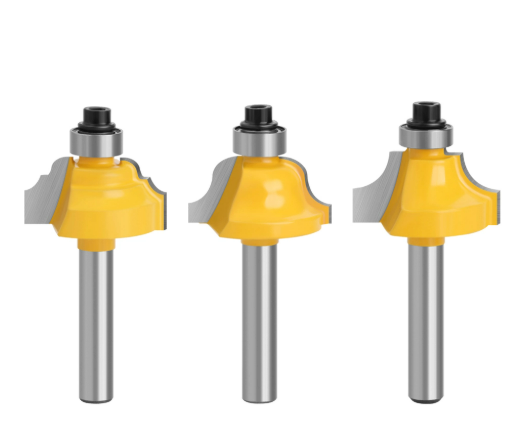
Selecting the correct profile size requires a disciplined evaluation. The bit's designated radius determines the exact sweep of the curve. Choosing blindly leads to aesthetic failure or ruined stock.
You must evaluate your sizing using a strict ratio. The cutting radius should ideally measure half the material's total thickness or slightly less. This approach leaves a small, flat vertical reveal at the center of the board. If you round both the top and bottom faces, this flat reveal prevents the two curves from meeting at a sharp, fragile peak.
Industry standards provide a reliable baseline for everyday woodworking. Following these conventions ensures structural integrity and visual harmony.
Material Thickness | Recommended Bit Radius | Resulting Profile Characteristics |
|---|---|---|
1/2-inch Stock | 1/4-inch Radius | Balanced edge, leaves a clean 1/4-inch flat reveal if routed on one side. |
3/4-inch Stock | 3/8-inch Radius | Substantial curve, highly ergonomic for desk edges. |
3/4-inch Stock | 1/2-inch Radius | Deep curve, leaves a minimal 1/4-inch flat center strip. |
1-inch Stock | 1/2-inch Radius | Standard bullnose approach, leaving ample flat surface for stability. |
Beginners often make a catastrophic error. They select a radius larger than the stock thickness itself. For example, using a 3/4-inch radius bit on a 1/2-inch thick board destroys the edge entirely. The blade cuts past the bottom of the wood. The guide bearing instantly loses its physical riding surface. The tool aggressively pulls itself deeper into the workpiece. This destroys the material and creates a severe safety hazard. Always verify your material thickness matches your tooling.
Budget tooling costs more in the long run. Professional shops prioritize Total Cost of Ownership (TCO). High-performance tools reduce material waste and save hours of sanding.
You will encounter two primary cutting materials on the market. High-Speed Steel (HSS) offers a lower initial price. However, HSS dulls incredibly fast on dense hardwoods. Engineered materials like MDF or plywood will destroy an HSS edge in minutes. Dull blades cause friction burns and severe wood splintering.
Carbide-tipped bits represent a mandatory investment for serious work. Premium options use high-density TiCo (Titanium Cobalt) carbide. These micro-grain structures stay razor-sharp significantly longer. They slice cleanly through difficult end-grain. Over a year of standard use, a single carbide tool drastically outperforms multiple HSS replacements.
Material Type | Initial Cost | Lifespan on Hardwoods | Risk of Friction Burns | Overall TCO Rating |
|---|---|---|---|---|
High-Speed Steel (HSS) | Very Low | Extremely Short | High | Poor |
Standard Carbide-Tipped | Moderate | Long | Low | Excellent |
TiCo High-Density Carbide | Premium | Exceptional | Very Low | Superior |
Heat destroys cutting edges. As sap and resin build up on the steel body, friction skyrockets. Look for modern anti-friction coatings. Polytetrafluoroethylene (PTFE) or specialized Perma-SHIELD layers prevent pitch accumulation. These non-stick surfaces keep the bit running cool. A cooler bit maintains its sharp edge and prevents unsightly burn marks on cherry or maple.
Hand-held routing demands strict physical control. Anti-kickback body designs provide essential safety. Manufacturers engineer enlarged steel shoulders right behind the cutting edge. This geometry physically limits the feed rate per revolution. It prevents the blade from grabbing too much material in a single bite. You experience smoother cuts, fewer kickbacks, and greatly enhanced stability.
Production environments face high tooling turnover. Replacing heavy carbon-steel bit bodies repeatedly wastes capital. Insert tooling solves this problem perfectly. These specialized tools feature replaceable carbide inserts screwed onto a permanent steel body. When the edge dulls, you simply rotate or swap the small carbide blade. It proves far more cost-effective for high-volume manufacturing.
Different disciplines demand unique approaches to edge treatment. A dining table requires a different geometry than an electric guitar.
Custom furniture relies heavily on edge profiling. A sharp 90-degree corner on a dining table feels uncomfortable against the arms. A simple 3/8-inch softened corner provides immediate ergonomic relief. Craftsmen also use Router Bits to create decorative bead edges. Plunging slightly deeper creates a deliberate architectural step. This adds classic detailing to cabinet doors and shelving.
Guitar building requires extreme precision. Luthiers adhere to strict historical dimensions. Softening a guitar body is not merely aesthetic. It dictates how the instrument rests against the musician.
1-inch radius: Used heavily for roughing-in guitar necks. It quickly removes bulk material before final hand-shaping.
7/16-inch radius: The undisputed industry standard for Strat-style bodies. It creates a deeply comfortable contour.
3/16-inch radius: The classic profile for Tele-style bodies. It leaves a sharper, more defined vintage edge.
1/8-inch radius: Used specifically for the back edges of Les Paul-style bodies. It slightly breaks the sharp edge without altering the thick mahogany aesthetic.
Modern shops frequently blend manual and automated techniques. Manual router tables utilize convex profile tools for quick, one-off projects. If you need to round a single tabletop, a manual setup takes five minutes. It remains highly efficient.
Computer Numerical Control (CNC) equipment changes the equation. Standard bearing-guided tools fail on CNCs. The machine cannot plunge safely, and software struggles to calculate complex undercuts. Instead, CNC programmers rely on a clever workaround. They use a simple ball nose bit. They program an ultra-low stepover parameter, often around 0.1mm. The machine runs hundreds of overlapping passes. This generates a perfectly smooth, sanded-like round edge. You trade longer machine running time for absolute tooling simplicity.
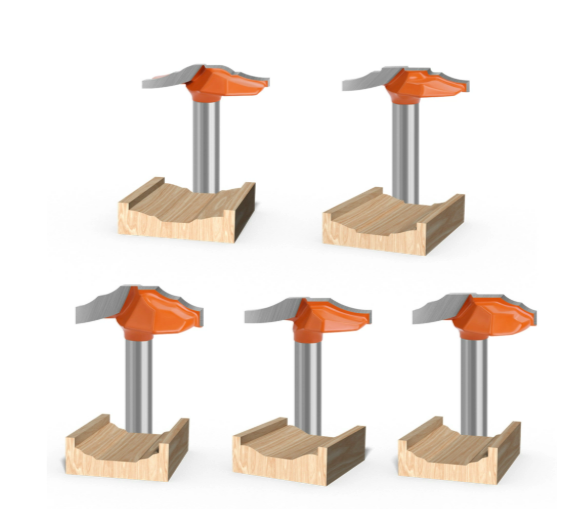
Even premium tools perform poorly if set up incorrectly. Mastering the physical execution prevents frustrating defects.
Beginners constantly face one specific failure. They complete a pass and discover a visible ridge left at the top of the curve. The transition from flat face to curve feels bumpy. This "step" usually indicates a severe setup error, not a defective tool.
Your cutting depth is set too deep. The router base sits too high relative to the cutter. Take a close look at your bit profile. There is a straight, vertical cutting edge situated directly above the sweeping curve. If you plunge too deep, this straight portion digs into the wood surface. It carves an unwanted square channel. You must adjust the base. Ensure only the curved portion of the blade contacts the wood. The vertical straight cutter must remain completely hidden inside the router base.
Taking the full profile in a single, heavy pass invites disaster. Dense hardwoods naturally resist heavy cutting forces. End-grain sections contain brittle fibers. Forcing a massive cut causes violent tool chatter and severe tear-out.
Professionals always "sneak up" on the final dimension. Follow this progressive method for flawless results:
Set a Shallow Depth: Adjust your base so the bit only exposes half of the desired profile.
Make the First Pass: Run the tool steadily along the edge. Let the machine do the work without forcing the feed rate.
Lower the Base: Expose more of the blade for a deeper secondary cut.
Execute the Final Pass: Drop the bit to the final desired depth. This last pass should only shave off a paper-thin layer of wood.
This progressive strategy prevents brutal tear-out. It dramatically reduces tool chatter. It keeps the blade cool, extending its lifespan. Most importantly, it gives you maximum physical control over the spinning cutter.
Rounding edges properly demands thoughtful tool selection and disciplined execution. Guessing your tool dimensions or skipping setup tests will inevitably ruin costly hardwood.
Keep these action-oriented next steps in mind for your shop:
Start with a Core Set: You do not need fifty different profiles. Build a strong foundational set. Purchase 1/8-inch, 1/4-inch, and 3/8-inch carbide-tipped round-over bits. These three sizes cover ninety percent of daily workshop tasks.
Prioritize Stability: If your equipment allows it, always choose 1/2-inch shanks. The reduced vibration yields a significantly smoother finish.
Verify Your Hardware: Always double-check your machine's collet size before making a purchase. A 1/2-inch shank will not fit into a standard trim router.
Always Run Test Cuts: Never execute a new depth setting directly on your final project. Always run a test pass on scrap material of identical thickness. Validate the curve and adjust the bearing height before committing to the real workpiece.
A: The cutting depth is set too low. The straight, vertical portion of the bit located just above the curve is aggressively digging into the wood. To fix this, raise the bit closer to the router base until only the radius curve engages the material.
A: Generally, no. Standard bearing-guided bits are designed for manual feed operations. CNC operations typically use 3D profiling with ball nose bits or specialized non-bearing profile bits to avoid physical hardware collisions and complex software pathing issues.
A: A round-over bit creates a perfectly smooth transition from the top face directly to the side edge. A beading bit cuts the exact same radius but intentionally leaves a small, decorative square step (a fillet or bead) at the top or bottom of the profile.


