
Views: 0 Author: Site Editor Publish Time: 2026-05-07 Origin: Site


Transitioning from standard edge routing to custom architectural millwork requires a strategic approach to tooling and technique. Fabricating your own crown, baseboard, or casing profiles using Molding Router Bits offers substantial ROI compared to outsourcing or purchasing pre-milled stock. You gain complete creative control over your millwork while avoiding frustrating supplier lead times. However, this level of custom fabrication demands a deep understanding of operational mechanics. Heavy-duty routing introduces intense physical forces into the workshop environment. You must respect these forces to produce safe and consistent results.
This guide outlines the essential evaluation criteria for bit selection and risk-mitigated setup protocols. You will learn the exact step-by-step milling workflows required to achieve zero-defect, production-grade profiles. We will cover depth management, defect troubleshooting, and advanced finishing tactics to elevate your architectural projects.
Tooling ROI: Carbide-tipped bits offer the lowest Total Cost of Ownership (TCO) for hardwoods and high-volume runs compared to High-Speed Steel (HSS).
Risk Management: Large architectural bits demand router table stabilization and strict adherence to anti-climb-cutting feed directions.
Implementation Rule: Complex profiles require 3-4 shallow, incremental passes to prevent motor overload and material tear-out.
Defect Prevention: Splintering is mitigated by sequencing cuts (end-grain first, side-grain last) and maintaining a 1/16” shank gap in the collet to prevent high-frequency vibration.
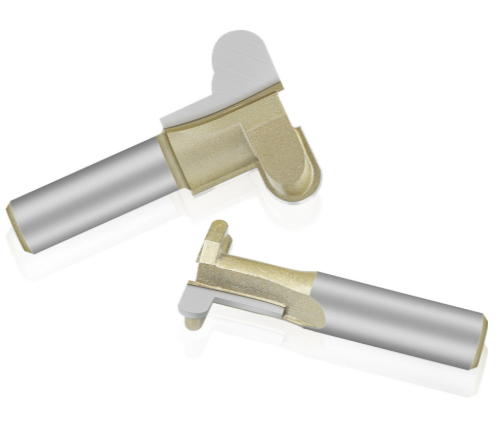
Selecting architectural tooling is a critical foundational step. Evaluating your options based on material constraints, project scope, and long-term costs ensures you invest wisely. You need to align the geometry of your cutters with the biological realities of the wood you plan to mill.
Tooling materials dictate both cut quality and lifespan. High-Speed Steel (HSS) offers an incredibly sharp initial edge. You should evaluate HSS for occasional, low-volume projects utilizing softwoods like pine or cedar. However, HSS dulls rapidly under friction. For hardwoods like oak or maple, MDF, or commercial-scale consistency, Carbide-tipped bits become mandatory. Carbide withstands extreme temperatures without losing its edge. This durability minimizes dulling and drastically reduces your replacement frequency.
Tooling Material | Primary Advantage | Best Material Fit | Durability & TCO |
|---|---|---|---|
High-Speed Steel (HSS) | Sharper initial cutting edge. | Softwoods (Pine, Cedar), light DIY. | Low durability; high long-term cost for heavy use. |
Carbide-Tipped | High heat and abrasion resistance. | Hardwoods (Oak, Walnut), MDF, Plywood. | High durability; excellent TCO for volume runs. |
Assess your exact project requirements before buying. Producing architectural crown molding often requires an integrated set of tools. You typically need specialized edge molding bits to cut the 38° and 52° spring angles alongside the dedicated profile cutters. Buying complete sets improves your project ROI. Integrated sets ensure precise profile interlocking out of the box. Purchasing single bits piecemeal frequently leads to mismatched angles and frustrating assembly gaps.
You must factor wood behavior into your tooling budget. Wood fibers react differently depending on the cutter's attack angle. For unpredictable hardwoods prone to tear-out, factor spiral upcut designs into your workflow. These advanced Router Bits provide superior shearing action and much cleaner chip extraction. Standard straight-fluted bits suffice for highly predictable, straight-grained softwoods. Matching the bit geometry to the wood species prevents costly material blowouts.
Establishing a compliant, risk-free environment is non-negotiable for heavy-duty routing. Architectural bits remove massive amounts of material. This creates extreme rotational inertia and significant kickback hazards.
Acknowledge the implementation reality immediately. Heavy architectural bits are fundamentally unsafe and entirely inaccurate in handheld operations. The large diameter of these cutters can easily pull a handheld tool out of your grip. Securing the machine under a heavy-duty, specialized router table is a strict requirement. This setup allows for "face-down" milling. Keeping the wide face of the stock fully supported against the table guarantees stability, safety, and a uniform profile depth.
Never bottom out the bit shank inside the collet. When you insert the shank until it hits the bottom of the armature shaft, it cannot tighten properly. As the collet nut compresses, the collet wedges need room to pull downward. If the shank is bottomed out, it restricts this downward movement. Always leave a 1/16” to 1/8” gap. This vital spacing allows the collet to tighten fully around the shank. Ignoring this rule creates high-frequency vibrations. These vibrations lead to deep chatter marks on your wood or catastrophic bit ejection during operation.
Routinely check your blades for the "white line" reflection. A razor-sharp cutting edge is microscopic and reflects zero light. When a bit dulls, the edge flattens out into a rounded surface. This flat edge catches ambient workshop lighting, appearing as a distinct white line along the blade. Operating a machine with dull bits drastically increases friction. This friction leads directly to stock kickback, permanent motor burnout, and severe material waste from burning.
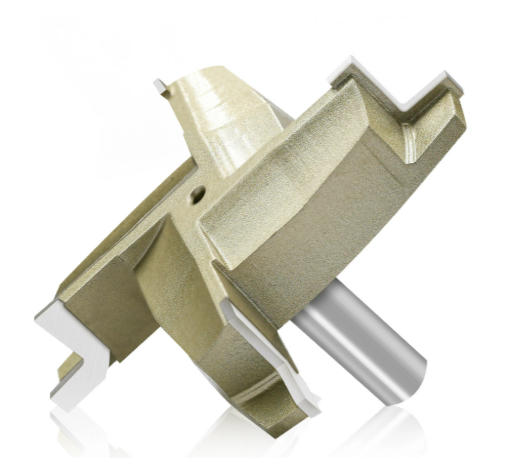
Executing precise layouts and strict depth management ensures consistent, scalable outcomes. You cannot rush the milling process when handling complex architectural profiles.
Pre-calculate your dimensions before you begin milling. You must account for structural mounting angles alongside the decorative surface. For example, if you are milling custom crown molding from a 2-1/2" wide board, you must allocate specific zones. Reserve 3/4" of width entirely for the crown mold edge (the structural bevel). This leaves a precise 1-3/4" allowance for the decorative profile surface. Mapping this out prevents overlapping cuts and ruined stock.
For crown molding applications, mill the structural mounting angles first. These angles allow the molding to bridge the 90-degree corner between the ceiling and the wall. You will rout one side of the board face-up. You will then rout the opposite side face-down. This alternating technique generates the standardized 52° ceiling and 38° wall mating surfaces required for seamless installation.
Never attempt full-depth profile cuts in a single run. Heavy material removal overwhelms the motor and rips fibers from the board. Program your workflow for a structured series of passes.
First Pass: Set the bit height to remove roughly 40% of the target material profile. Feed the stock slowly to gauge resistance.
Second Pass: Raise the bit to clear another 40% of the material. Listen to the motor pitch; it should remain steady.
Third Pass: Advance to 95% of the final depth. Check your progress and blow away excess chips from the table fence.
Final Pass: Use a straight edge against the bit to calibrate the final, thinnest pass. This micro-pass guarantees maximum precision and an ultra-smooth finish.
Always conduct a micro-depth test pass on scrap material first. Use pencil marks on the wood to verify the bit’s lateral cutting limits. Run the scrap piece a few inches past the cutter. Inspect the resulting profile closely. Adjust the router fence immediately if the profile exhibits any asymmetry. You want to catch alignment errors on scrap wood, not on expensive hardwood stock.
Addressing common quality-control failures early keeps your project on track. Wood behaves unpredictably under stress, but structural defects are entirely preventable with the right techniques.
Prevent blowouts on square stock by mastering the golden sequence of routing. Tear-out almost always occurs when the bit exits cross-grain cuts. To eliminate this, you must route the cross-grain (end-grain) first. Follow this immediately by routing with-the-grain (side-grain). When you rout the end-grain, the back corner will likely splinter. However, the subsequent side-grain passes automatically mill away that damaged corner, leaving a flawless, sharp edge.
Chatter presents as wavy surface textures, while burn marks appear as scorched brown lines. Both defects are direct results of operational errors. Force-feeding stock too quickly causes chatter because the bit cannot clear chips fast enough. Burn marks happen when you pause mid-cut or run the bit at excessive RPMs. You must reduce your feed speed and dial down the router’s variable speed dial. Large-diameter bits travel much faster at their outer edges, requiring significant RPM reductions.
RPM Recommendation Chart for Architectural Bits
Bit Diameter | Maximum Recommended Speed (RPM) | Primary Risk of Exceeding RPM |
|---|---|---|
Up to 1" | 24,000 RPM | Premature dulling of the cutting edge. |
1" to 2" | 18,000 RPM | Severe friction burns on the wood. |
2" to 2-1/2" | 16,000 RPM | Intense vibrations and chatter marks. |
Over 2-1/2" | 12,000 RPM | Catastrophic bit failure or tool ejection. |
Ensure your feed direction always opposes the bit's rotation. On a standard router table setup, the bit rotates counter-clockwise. Therefore, you must feed your stock from right to left. Moving left to right initiates a climb cut. Climb cutting allows the bit's teeth to grab the wood and violently pull it forward. This pulls the stock completely out of the operator's control. Climb cutting on a router table is a critical safety failure.
Finalizing the product correctly prevents you from destroying the intricate milled details you just created. Heavy sanding ruins crisp architectural lines.
Avoid using rigid sandpaper blocks on complex Ogee, cove, or bead profiles. A flat, rigid block will quickly flatten out the delicate transitions and crisp edges. You need the abrasive to contour to the wood. Utilize non-woven sanding pads or flexible sanding sponges. These materials conform easily to complex curves. They remove minor machine marks without altering the underlying geometry of the architectural millwork.
Experienced operators often bypass heavy sanding altogether. You can perform one final, hair-thin pass to achieve a near-glass finish directly off the machine. Set your fence so the bit removes no more than 1/64 of an inch. Feed the material smoothly and continuously. This technique slices away microscopic fuzzy fibers. It yields an incredibly polished surface, reducing manual sanding time by up to 80%.
For ultra-thick, high-end architectural trim, you do not need impossibly massive router bits. Instead, use a layered assembly approach. Route several standard 3/4" boards with complementary, smaller profiles. Stack and layer them progressively during the room installation. Building up layers mimics the massive, imposing look of expensive, solid 8/4 custom millwork. It is safer to mill, easier to handle, and vastly more cost-effective.
Transitioning to in-house custom millwork is a high-ROI capability for serious woodworkers and contractors. By executing the strategies outlined above, you can elevate your shop's output drastically. Success relies entirely on selecting the correct carbide profiles, rigorously controlling feed rates through multiple shallow passes, and leveraging a secure router table setup.
Standardize your setup: Always utilize a router table for architectural profiles to ensure safety and consistent support.
Pace your cuts: Commit to 3-4 incremental passes to protect your motor, preserve your bits, and eliminate tear-out.
Adopt the golden sequence: Route end-grain before side-grain to effortlessly clean up splintering on square panels.
Layer for impact: Combine multiple smaller 3/4" profiles to construct massive, elaborate architectural trim pieces safely.
By strictly enforcing these layout calculations and defect-prevention sequences, you can consistently produce premium architectural elements. Your custom work will easily outpace off-the-shelf alternatives in both cost-efficiency and design flexibility.
A: While initial hardware costs (router, table, and bit sets) require upfront capital, molding router bits pay for themselves quickly in high-linear-foot projects. They also eliminate the long lead times and high premium markups associated with ordering custom hardwood millwork profiles from specialized lumberyards.
A: It is highly discouraged and incredibly dangerous. Due to the large diameter and significant material removal of architectural bits, using them handheld introduces severe kickback risks. A sturdy router table equipped with a reliable fence is absolutely required for safety, support, and depth consistency.
A: Burn marks are caused by excessive friction and heat buildup. Prevent them by lowering the router's RPM (larger bits require significantly slower speeds). You must also take multiple shallow passes rather than one deep cut. Most importantly, maintain a steady, uninterrupted feed rate to prevent heat accumulation in one spot.


