
Views: 0 Author: Site Editor Publish Time: 2026-10-08 Origin: Site


Transitioning from traditional brazed carbide to insert-style tooling is a distinct operational upgrade. It is far more than just a simple purchase. Surfacing a spoilboard remains mandatory for consistent CNC accuracy. However, tooling costs and machine downtime scale up very quickly. Standard surfacing bits require routine sharpening when they dull. This maintenance process reduces their overall cutting diameter. It alters your Z-axis zeroing and creates frustrating production downtime. You essentially lose money every time the machine stops. We introduce insert-style bits as a low-operational-cost alternative. They require a higher upfront investment but deliver long-term savings. This guide evaluates exact operational breakpoints for upgrading your tooling. We analyze daily production volume, specific machine capabilities, and financial returns. You will learn exactly when making the switch is objectively justified. We want you to make the most profitable decision for your shop.
Insert style bits carry a higher initial investment but drastically reduce the long-term "cost per cut" by allowing operators to rotate or replace inexpensive carbide blades.
Replacing inserts guarantees the bit's original diameter and profile remain unchanged, eliminating the need to recalculate toolpaths after maintenance.
An insert spoilboard router bit requires a rigid machine setup with sufficient horsepower; they are not universally compatible with entry-level, low-torque desktop routers.
The crossover point for ROI typically occurs after the third time a shop would have otherwise paid to sharpen a traditional brazed carbide surfacing bit.
You must compare the initial purchase price of a brazed carbide bit against an insert-style body. Solid carbide bits look appealingly cheap at first glance. An insert-style tool body costs significantly more upfront. We have to look at the lifecycle cost to see the true value. You are buying a permanent tool body.
Let us detail the replacement math carefully. Replacing two to four small carbide inserts costs merely a few dollars. Buying a brand-new traditional bit is highly expensive. Sending one out for professional sharpening also drains resources. You pay for the sharpening service and the shipping fees.
Minimizing machine downtime provides a massive operational advantage. You can rotate an insert blade 90 degrees right at the machine. Use a simple Torx key to loosen the screw. This entire process takes under two minutes. Conversely, removing and shipping a traditional bit stops your production workflow completely.
Hardware strike mitigation is another serious reality. Operators occasionally hit embedded spoilboard screws. Striking a screw with an insert bit shatters the inserts. This mistake costs you a few dollars for replacement blades. Striking a screw with a traditional bit destroys the entire tool. You must buy a completely new bit immediately.
Scenario | Traditional Brazed Carbide Bit | Insert Style Tooling |
|---|---|---|
Tool Dulling | Remove bit, pay for sharpening, wait days. | Rotate insert 90 degrees in 2 minutes. |
Diameter Change | Diameter shrinks, CAM toolpaths need updating. | True diameter maintained permanently. |
Hardware Strike | Entire tool destroyed, requires full replacement. | Inserts shatter, replace for a few dollars. |
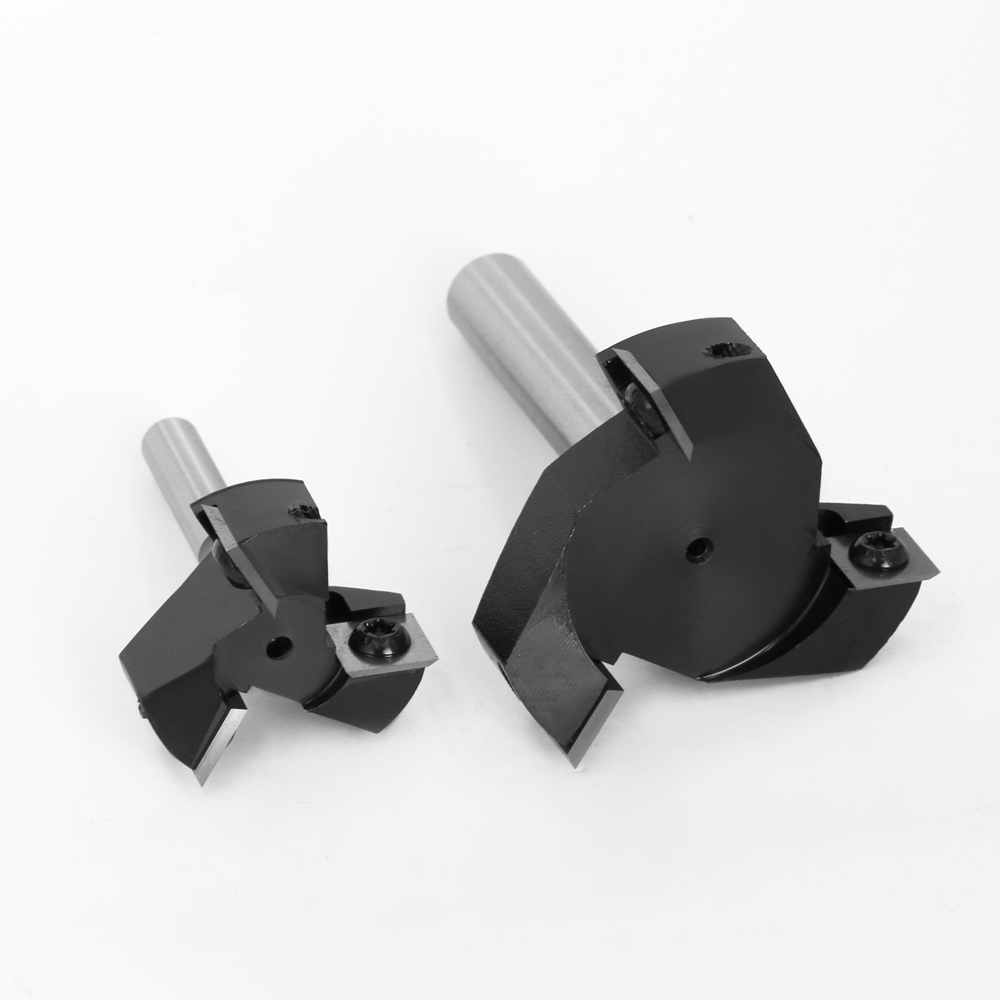
Quality insert bits usually require a 1/2-inch collet. You need this robust shank size for safety reasons. It handles the larger mass and strong rotational forces effectively. Using a 1/4-inch shank for heavy surfacing invites dangerous tool deflection.
Insert bits are noticeably heavier than standard tools. They feature larger cutting diameters, often spanning 1.5 to 3 inches. You must evaluate the minimum spindle horsepower required. Weak spindles will stall or bog down during a heavy pass. We recommend at least a 2.2kW or 3HP spindle for optimal performance. Large bits demand adequate torque to maintain consistent chip loads.
Spindle tramming sensitivities also require your attention. Tramming refers to the perfect perpendicular alignment of your spindle to the table. Larger CNC Router Bits used for flattening exaggerate any spindle misalignment. A tramming error will leave distinct ridge lines across your freshly surfaced MDF. You need strict machine rigidity to support these heavy-duty cutters.
Consider these hardware checks before upgrading:
Verify your spindle has a 1/2-inch collet capacity.
Confirm your spindle horsepower exceeds 2.2kW.
Tram your spindle perfectly to ensure a flat cut.
Check your gantry for excessive play or deflection.
Dimensional consistency solves major programming headaches. Standard bits lose microscopic amounts of diameter when you sharpen them. This alters your stepover distances slightly. An Insert Spoilboard Router Bit maintains absolute true diameter perfectly. You ensure consistent stepovers and flawless overlaps every single time. You never have to modify your CAM software parameters after a tool change.
Replaceable inserts feature advanced carbide grades. Manufacturers use harder, more specialized sub-micrograin carbide for these blades. Cheaper bits use softer carbide grades brazed onto steel. Sub-micrograin carbide handles abrasive materials remarkably well. MDF spoilboards are packed with highly abrasive glues and resins. Insert blades power through MDF much longer before becoming dull.
We also love the multi-edge utility of these tools. Most inserts utilize a clever four-sided design. An operator gets four fresh cutting edges per insert. You simply loosen the screw and rotate the square blade. You do not need to purchase replacements until all four sides wear out. This extends the lifespan of a single pack of inserts tremendously.
Insert tooling does not fit every single workshop perfectly. Acknowledge low-volume or hobbyist environments first. Some shops only surface their spoilboard once every six months. In this specific scenario, the ROI on an insert body takes years. A cheaper traditional bit makes better financial sense for infrequent use.
Entry-level desktop CNCs present another valid exception. We strongly warn against using heavy insert bits on belt-driven machines. Low-rigidity machines populate many maker communities today. The heavy mass of an insert tool causes severe chatter. It induces router deflection and forces stepper motors to miss steps. Stick to smaller brazed bits for these lightweight desktop routers.
Budget-restricted pilot projects should also wait. Shops often spend months testing their primary workflows. You might not be ready to invest in permanent, industrial-grade systems. We recommend traditional bits during this experimental phase. Upgrade your tooling once your production volume stabilizes.
Common Mistakes in Tool Selection:
Buying a massive 3-inch insert bit for a desktop router.
Ignoring collet size limitations before purchasing.
Upgrading tools before fixing spindle tramming issues.
Purchasing cheap, low-grade replacement inserts online.
You must provide a framework for determining safe RPMs. Insert bits require lower RPMs than standard cutting tools. Their larger mass and wide diameter dictate this speed reduction. Running them too fast causes severe vibration. Determine appropriate feed rates carefully. Incorrect speeds will burn the MDF. You might also leave ugly ridge lines if you feed too slowly.
Stepover percentages require specific tuning. We highly recommend standard stepover parameters between 40 and 60 percent. This specific range works best for insert-style cutting profiles. It guarantees a glass-smooth finish across the entire table. Higher stepovers risk leaving uncut material between passes. Lower stepovers waste valuable production time.
Safety and maintenance protocols dictate your success. We emphasize the necessity of cleaning insert pockets frequently. Always clean the pocket before rotating a blade. Use compressed air or a stiff nylon brush. A tiny amount of packed dust creates massive problems. Dust behind an insert offsets the blade height physically. This offset causes uneven cuts and potential catastrophic tool failure.
We can summarize this decision framework quite easily. You should evaluate your exact shop parameters today. High-production shops need durable, reliable tooling solutions. If you surface spoilboards monthly, you waste money sharpening traditional bits. You must have a rigid machine equipped with a 1/2-inch collet. If you meet these criteria, the transition to insert tooling is necessary. It drives your long-term efficiency upward.
Take actionable next steps this week. Audit your current spoilboard surfacing frequency. Write down exactly how often you perform this task. Check your spindle horsepower and tramming accuracy. Gather these specifications before selecting a specific brand. Buy the correct diameter of insert bit for your machine. This strategic upgrade will eliminate downtime and reduce your cutting costs.
A: Rotation frequency depends strictly on surface area and material abrasiveness. They typically last three to four times longer than a standard bit edge. Manufacturers use specialized carbide grades optimized for cutting abrasive MDF.
A: Yes, woodworkers widely use these tools for slab flattening. You must adjust your feed rates accordingly. Decrease your depth of cut based on the exact wood density to prevent tear-out.
A: No. While some use standard 14x14x2mm dimensions, many brands use proprietary hole placements. Some use unique bevel angles. Always check replacement insert availability before purchasing the initial bit body.
A: Lines point to either a tramming issue with your CNC spindle or improper maintenance. Dust trapped behind one of the newly rotated inserts causes uneven blade height. Clean pockets thoroughly.
