


Whether you’re just starting out or stepping up from basic projects, learning to use router bits safely and efficiently unlocks a huge range of woodworking possibilities. This practical, visual-first guide from LAIWEI Tools walks you through router anatomy and safety, mounting and depth-setting, common bit types with real use-cases, cutting direction and feed-rate tricks to avoid tear-out, and recommendations from our catalog so you can match the right bit to the job.

A router’s performance depends as much on the tool as on the bit. Key components to understand:
Collet — the clamping sleeve that grips the bit shank. Collets come in standard shank sizes (1/4" and 1/2") and must be clean and undamaged to ensure concentricity.
Base — fixed bases are simple and stable; plunge bases let you lower the bit into the work mid-cut for mortises, stopped grooves, or inlay work.
Motor and speed control — many routers have variable speed dials. Larger-diameter bits require slower RPMs; smaller bits can spin faster for clean cuts.
Depth stop and micro-adjust — essential for precise, repeatable cuts when using templates or making joinery.
Safety is non-negotiable. Before you touch the trigger:
Inspect the bit for chips, cracks, or loose carbide tips. Replace damaged bits immediately.
Secure the workpiece with clamps or a firm workstation; never hold small pieces by hand while routing.
Wear eye protection and hearing protection; a dust mask or respirator is recommended for prolonged routing.
Ensure the router is unplugged while changing bits and that the collet wrench fits snugly.
Confirm rotation direction (usually clockwise when viewed from above) and that the bit will cut into the stock in the intended direction.
Keep both hands on the router; use a guide or edge fence for consistent cuts.
Shank size matters. 1/2" shanks offer better rigidity and less vibration, which is important for larger-diameter bits and plunge work; 1/4" shanks are fine for small profile work and trim bits. If your router accepts both, prefer a 1/2" shank when possible — it translates to cleaner cuts and longer bit life.
Insert the bit into the collet so that at least 3/4" of shank is inside the collet — too shallow invites slippage, too deep can reduce grip length. Tighten the collet nut firmly using the router’s wrenches; avoid over-torquing which can damage the collet. A good rule: tighten, then apply the router to a scrap cut, re-tighten, and test again.
For clean cuts and to reduce strain on the router and bit, make multiple light passes rather than one deep cut. Start with a shallow pass (1/16"–1/8") and increase incrementally. Use a fence, template, or edge guide for accuracy. When stacking depth stops for repeated batches, label or mark the stop positions to reproduce the setup quickly.
Straight bits are the workhorse for cutting dados, rabbets, and through or stopped grooves. Use them for shelving dados, hinge mortises, or template-guided slot cutting. For long, consistent grooves use a fence; for template work use a bearing-guided straight bit or a separate guide bushing.
Roundover bits soften sharp edges and create durable, finished profiles for tabletops, shelves, and furniture edges. Chamfer bits cut angled edges for aesthetics or to ease joinery. Choose a radius that matches the scale of the workpiece; smaller radii for trim, larger for tabletops.
Cove bits make concave channels; ogee and Roman ogee bits produce classic decorative contours used on furniture and moldings. These bits are ideal for finishing door panels, table aprons, and picture frames. Always test the profile on scrap to confirm the look before cutting finished pieces.
Dovetail bits create flared tails for drawer bottoms and boxes that fit into complementary sockets; box-joint (finger) cutters are for tightly interlocking corner joints. Jigs greatly simplify accurate dovetail and box-joint cutting; consider a router table or jig for repeatable results.
Trim bits with bearings ride against the workpiece or template to copy shapes, trim veneers, and flush up laminates. They’re indispensable for template routing, door trimming, and veneer cleanup. Bearing-guided bits make fast work of complex shapes when combined with a robust template.
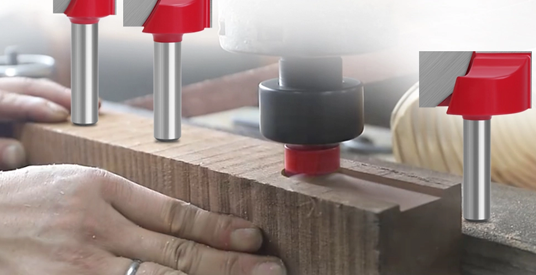
Conventional cut (router moving left-to-right on an edge while spinning clockwise) is safest and gives controlled chip formation. Climb cutting (reverse feed) can produce very clean edges on tricky grain, but it feeds the work into the bit and can pull the router unexpectedly — only use climb cutting when you can securely clamp the work, using a router table or with progressive, controlled cuts.
To minimize tear-out on figured woods or plywood:
Cut shallow passes.
Position the grain so the bit meets fibers progressively, not tearing them.
Use a backer board clamped to the work to support fibers at the exit point.
Consider spiral-fluted bits that shear wood fibers more cleanly.
Finish the edge with a very light scrape or hand sanding after routing for a flawless surface.
When copying shapes from a template, choose a bit with a bearing sized for the template offset you need. Use guide bushings for plunge routing where bearings are impractical. Clamp the template securely and always route in the same direction relative to the bearing to avoid undercutting.
Plunge routing lets you start cuts in the middle of a panel. Use plunge bits with a spiral or down-shear flute for clean entry. Practice plunge depth control on scrap, and always ensure the router’s plunge mechanism locks solidly before making a controlled plunge cut.
For cabinetry, straight bits for dados, rabbets, and hinge mortises are essential. Combine them with a few profile bits — a 1/4" roundover, ogee for face frames, and a bearing-guided flush-trim bit for template work. LAIWEI Tools’ carbide-tipped straight bits maintain edge life in plywood and veneered panels.
Trim and finish work benefits from 1/4" shank trim bits, chamfer bits, and small-radius roundovers. Bearing-guided trim bits from our catalog are made with optimized chip channels to prevent clogging when trimming laminates or MDF.
For signmaking and carving, V-groove bits, ball-nose bits, and small-diameter spiral bits provide crisp detail. Carbide-tipped V-groove bits from LAIWEI Tools are engineered for longevity and consistent geometry, making repeated shallow passes faster and cleaner.
Short product callouts:
Carbide straight bits — great for dados and hinge mortises; long-lasting on plywood.
Bearing-guided flush trim bits — ideal for templates and laminates.
Spiral down-cut bits — clean entry for veneered surfaces and inlay work.
Explore our categories to match bits to tasks and see technical specs and recommended RPM ranges.
If you hear burning, reduce feed rate or increase RPM for a cleaner cut; dull bits or clogged flutes cause heat buildup.
Vibration or chatter suggests an improperly seated bit, a damaged collet, or excessive bit overhang — shorten overhang and check the collet.
For inconsistent profiles, check for runout by spinning the bit in the collet by hand; any wobble means replace the bit or collet.
Keep spare collets and a torque-appropriate wrench in your kit — quick swaps and correct clamping save time and avoid mistakes.
Store bits in protective cases; dirty or nicked carbide tips should be sharpened or replaced. Wipe flutes clean of resin and pitch after each session. Keep router vents clear and check motor brushes periodically. Never override safety guards or use a worn collet — precise clamping equals safer, more accurate routing.
Mastering router bits means combining safe setup, appropriate bit selection, and technique (feed direction, multiple passes, and the right shank size) to get predictable, professional results. LAIWEI Tools manufactures a broad range of carbide and HSS router bits that cover cabinetry, trim work, joinery, and sign carving — download our printable “router bits quick chart” and browse our best-selling options to find the perfect match for your next project. For product inquiries or technical support, contact us at LAIWEI Tools — we’ll help you choose the right carbide bits and get faster, cleaner routing on every job.


