
Views: 0 Author: Site Editor Publish Time: 2026-07-28 Origin: Site


Every woodworker knows the frustration of halting a project midway. You realize you are missing the exact router profile needed for a crucial joint. This forces sudden project delays and expensive ad hoc purchasing. It breaks your focus and drastically extends your delivery timeline.
Transitioning from buying individual bits to investing in curated Router Bit Sets serves as a strategic upgrade. They bring much-needed standardization and immediate capability to any workspace. You regain control over your timeline and eliminate redundant shipping costs. Building a reliable tooling baseline empowers you to tackle complex joinery instantly.
This guide explores how comprehensive sets directly improve daily workflow and overall efficiency. You will learn how to assess build quality, storage solutions, and long-term reliability. We will show you exactly what matters most before you finalize your purchase.
Workflow Continuity: A curated woodworking router bit set minimizes project downtime by keeping essential profiles (straight, flush trim, chamfer, roundover) immediately accessible.
Cost-per-Bit Ratio: Pre-packaged sets significantly lower the cost-per-bit compared to individual purchases, providing a predictable baseline investment for new and expanding shops.
Organization & Asset Protection: Factory-fitted cases prevent carbide chipping and streamline tool location, directly reducing setup times.
Quality Evaluation: High-efficiency sets are defined by micro-grain carbide thickness, anti-kickback designs, and appropriate shank sizing (1/2-inch vs. 1/4-inch), not just the total piece count.
Buying router profiles one at a time feels cheaper initially. However, this habit hides massive inefficiencies. You pay premium single-item prices every time. Shipping costs accumulate rapidly across multiple small orders. Worse, you lose days of working time waiting for packages to arrive. These micro-delays fracture your concentration. They turn a weekend project into a month-long ordeal. Purchasing router bit sets eliminates these hidden penalties completely.
A comprehensive set acts as a powerful force multiplier. You gain immediate access to diverse capabilities. You can transition from cutting dados to rounding edges in seconds. This flexibility encourages experimentation and better design choices. You no longer avoid specific joinery methods just because you lack the tooling. Your workshop instantly handles flush-trimming, complex grooving, and edge-forming without requiring secondary orders.
Think of your bit collection as a measurable workshop asset. A set establishes a baseline. Over time, you will naturally discover which profiles you use most frequently. Perhaps you wear out your quarter-inch straight bit first. You can then replace that specific tool with an ultra-premium version. The rest of the set continues serving you reliably. This approach optimizes your tooling budget and tracks depreciation systematically.
Marketing materials often highlight massive collections. However, functional workshops rely on a few specific profiles for 90% of daily tasks. You should isolate these utility shapes when evaluating a router starter kit.
Straight Bits (Joinery & Grooving): You need these for cutting dados, rabbets, and mortises. They form the foundation of cabinetry and structural joinery.
Flush Trim Bits (Templating): These feature a guide bearing. They are the absolute backbone of repeatable, pattern-based production. You use them to perfectly match veneers or copy curved templates.
Edge-Forming Bits (Finishing): Roundovers and chamfers break sharp edges. They make your finished pieces safer and more aesthetically pleasing.
Many massive collections contain obscure shapes. You might find complex architectural molding bits you will never touch. These filler pieces inflate the price and consume valuable storage space. We advise evaluating purchases based strictly on the inclusion of core profiles. High piece counts mean nothing if you only use five of them. Prioritize utility over sheer volume.
Profile Category | Common Examples | Workshop Utility Level | Primary Application |
|---|---|---|---|
Core Essentials | Straight, Flush Trim, Roundover | High (Daily Use) | Joinery, templating, edge easing |
Secondary Utility | Rabbeting, Chamfer, Cove | Medium (Weekly Use) | Cabinet backs, decorative edges |
Filler / Specialty | Multi-profile molding, Ogee | Low (Rare Use) | Specific architectural reproduction |
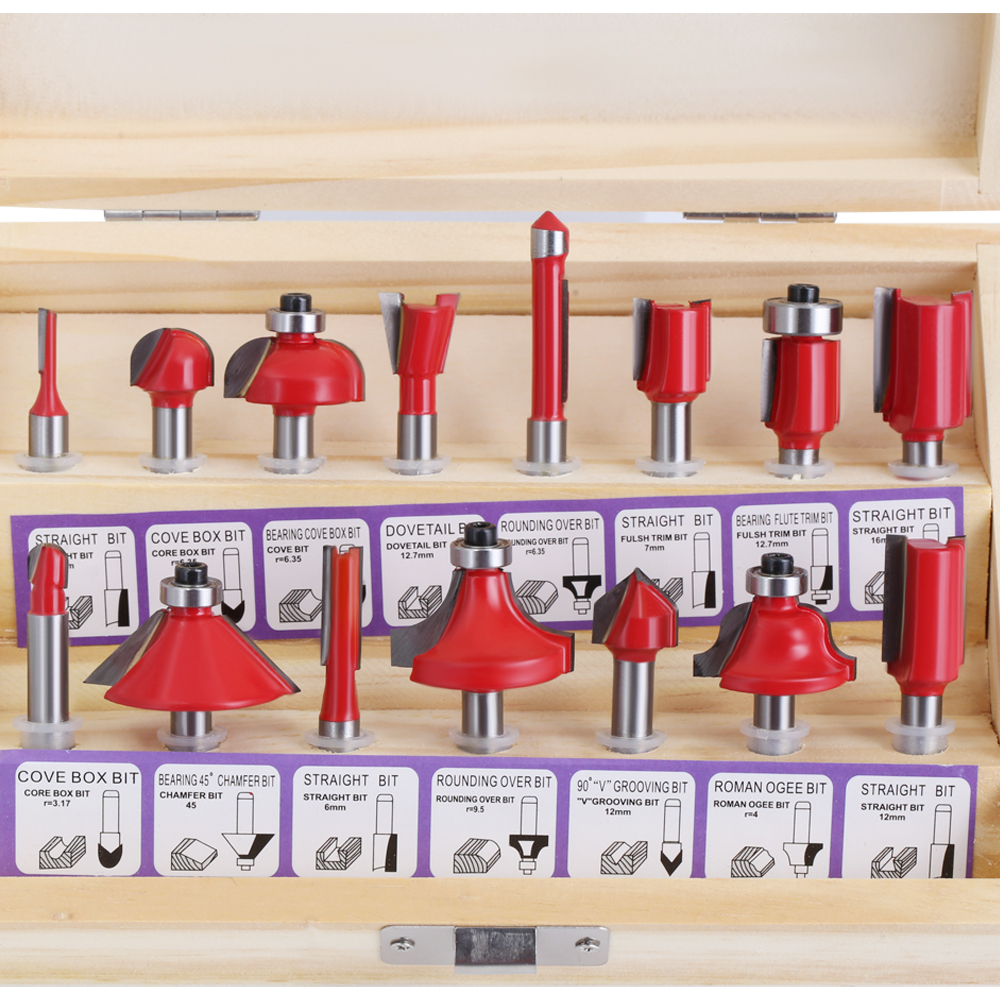
Tooling longevity depends entirely on material science. Standard high-speed steel (HSS) dulls quickly under heavy friction. We strongly recommend micro-grain carbide. The smaller grain structure creates a denser, tougher cutting edge. It holds its sharpness significantly longer. It also withstands the intense heat generated during continuous production runs. Thicker carbide slabs also allow for multiple professional sharpenings over the tool's lifespan.
Safety features dictate efficiency. Look for bits featuring a pronounced shoulder behind the cutting edge. This anti-kickback design physically limits how deeply the cutter can bite into the wood per revolution. It prevents aggressive over-feeding. This crucial feature reduces tear-out, limits material waste, and keeps your hands safe during manual routing.
Shank diameter heavily influences cut quality.
1/2-Inch Shanks: Recommend these for all standard workshop routers. The thicker steel provides superior mass. It minimizes vibration and eliminates chatter. This creates a remarkably smooth surface finish, directly reducing your sanding time.
1/4-Inch Shanks: Reserve these strictly for compact trim routers. They suit light-duty applications like edge-banding or delicate inlay work.
Guide bearings take immense abuse. Cheap bearings seize up when dust penetrates their housing. A seized bearing spins at 20,000 RPM, instantly burning your workpiece and ruining templates. Professional collections utilize enclosed, shielded bearings. These shields block fine dust ingress, ensuring smooth rotation and preventing costly workpiece damage.
Carbide boasts incredible hardness, but it remains surprisingly brittle. Tossing loose bits into a metal drawer spells disaster. When carbide edges strike each other, microscopic chipping occurs. These tiny chips ruin the cutting profile and leave streaks in your wood. Dedicated wooden cases or high-density foam inserts physically separate each tool. They prevent accidental collisions and preserve your cutting edges.
Efficiency relies on fast setups. Digging through loose bins creates unnecessary friction. Integrated storage cases typically feature clear labels for each slot. You can identify the exact profile, cutting length, and radius at a single glance. This visual inventory management accelerates your workflow. It also highlights missing tools instantly before you close the shop.
Bare steel shanks rust quickly in humid environments. Rust pits the shanks, causing them to stick inside your router collet. Closed storage cases create a localized micro-environment. You can drop a simple silica gel packet inside the box. This draws out ambient moisture. It protects the steel shanks and delicate bearing shields from degrading over time.
We often see beginners lured by 70-piece sets priced suspiciously low. These represent a major trap. Manufacturers achieve these prices by using extremely thin carbide and poor brazing techniques. These cheap tools suffer from poor balancing. They vibrate aggressively in the machine. This vibration fatigues the user, destroys router bearings, and leaves terrible finishes on the wood.
Not all bits spin at the same speed. Operating a massive cutter at maximum RPM creates a severe hazard. You must adjust your router's variable speed dial based on cutter diameter to ensure safe, efficient operation.
Up to 1-inch diameter: Safe to run at maximum speed (typically 22,000 - 24,000 RPM).
1-inch to 2-inch diameter: Reduce speed to roughly 18,000 RPM.
2-inch to 2.5-inch diameter: Reduce speed to 16,000 RPM.
Over 2.5-inch diameter (Panel Raisers): Must run at 12,000 RPM or slower.
Wood resin cooks onto hot metal during use. This dark, sticky buildup acts like insulation. It traps heat and drastically increases cutting friction. Users frequently throw away perfectly sharp bits, mistakenly believing they are dull. In reality, they just need cleaning. Routine maintenance with a dedicated resin solvent restores cutting efficiency and extends the set's usable life.
Before browsing, you must verify your machine's capabilities. Check your router collet sizes. Can it accept 1/2-inch shanks, or are you limited to 1/4-inch? Buying the wrong shank size halts your progress instantly. If your machine accepts both, always default to the larger diameter for stability.
Align your purchase with your actual production goals.
Small/Starter (12-15 pieces): Ideal for general carpentry and DIY weekend projects. They establish a solid baseline without overwhelming your budget.
Comprehensive (30-40 pieces): Suited for dedicated furniture makers. You get varied architectural profiles, multiple flush-trim lengths, and specialized joinery angles.
Shortlist two or three options from reputable tooling brands. Discard any brand that refuses to publish their carbide specifications. Prioritize companies offering transparent details on material grade and clear warranty terms. A trusted brand stands behind their brazing quality and bearing longevity.
Well-organized tooling fundamentally changes how a workshop operates. It represents a direct investment in your workflow continuity. You eliminate the friction of missing parts and focus entirely on crafting. Standardized tools provide consistent results across every project phase.
We advise starting with a high-quality, mid-sized woodworking router bit set to cover your primary tasks. Choose 1/2-inch shanks whenever possible for maximum stability. You can always supplement this foundation later. Buy premium individual specialty shapes only when advanced, specific projects demand them.
Take action today. Evaluate your current tooling gaps and check your router's collet capacity. Explore vetted starter kits tailored to your specific production needs. Upgrading your baseline tooling will immediately elevate the quality of your finished woodwork.
A: A set is more efficient and cost-effective for establishing a baseline of capabilities. It prevents workflow interruptions caused by missing profiles. Individual bits are better suited for replacing worn items from your existing set or acquiring highly specialized, one-off architectural profiles for unique projects.
A: 1/2-inch shanks offer more mass, less vibration, and greater stability. They deliver cleaner cuts in heavy-duty applications and prolong machine life. 1/4-inch shanks lack this mass. They are generally limited to smaller cutting profiles and are designed for compact trim routers.
A: Yes, provided the set features sufficiently thick micro-grain carbide. High-quality sets can be professionally honed multiple times, dramatically increasing their longevity. Conversely, cheap sets feature extremely thin carbide layers. These are often disposable, as they cannot withstand the grinding process.
A: Rarely. For most workshops, a well-machined 15 to 30-piece collection covers all daily functional requirements. You gain complete mastery over joinery, flush-trimming, and edge-forming. Massive sets force you into paying for obscure specialty profiles that will likely sit untouched in the box.


